
Whether you manage a high-risk model (high-risk), need payments in cryptocurrencies, or simply want lower minimum withdrawal amounts (from $10), There are alternatives to Stripe that will give you operational freedom that this platform usually restricts.
Here we have analyzed the most convenient and modern options for your business, because we know that Stripe is sometimes not the most convenient for you.
Why look for an alternative to Stripe in 2026?
The truth is that nowadays more and more entrepreneurs and companies are finding themselves with important limitations on the Stripe platform that directly affect your operations. and among the most common causes are:
Your business is considered high-risk (high-risk)
To begin, Stripe has a strict list of restricted or prohibited industries, as adult content, CBD, vaping, gambling, certain financial services, supplements or business models with high chargeback (alleged fraud).
That means that if Stripe rejected your account, froze it, or limits your volumes, a specialized alternative allows you to operate without fear of sudden interruptions.
You need to accept payments in cryptocurrencies
Another reason why people look for alternatives to Stripe is that this platform has limited support for crypto, mainly stablecoins in some markets.
Therefore, if your customers prefer to pay with Bitcoin, Ethereum, USDT, or other currencies, or if you want to offer that option as a competitive advantage, there are much more advanced and flexible payment processors in this regard.
You need faster withdrawals and lower minimums
Stripe usually requires higher withdrawal thresholds and standard settlement times. Today there are alternatives, such as RiskPayGo, that they allow you to withdraw from 10 USD (or even less).
But the most interesting thing is that they give you daily or instant settlements, which greatly improves your cash flow, especially if you are a small business or are just starting out.
Looking for less operational rigidity and better support
On the other hand, many companies feel that Stripe is very strict with the rules, account reviews and risk policies.
That is why modern alternatives usually offer more flexible onboarding, personalized support, and a lower likelihood of unexpected blocks.
The 5 best alternatives to Stripe according to your business model
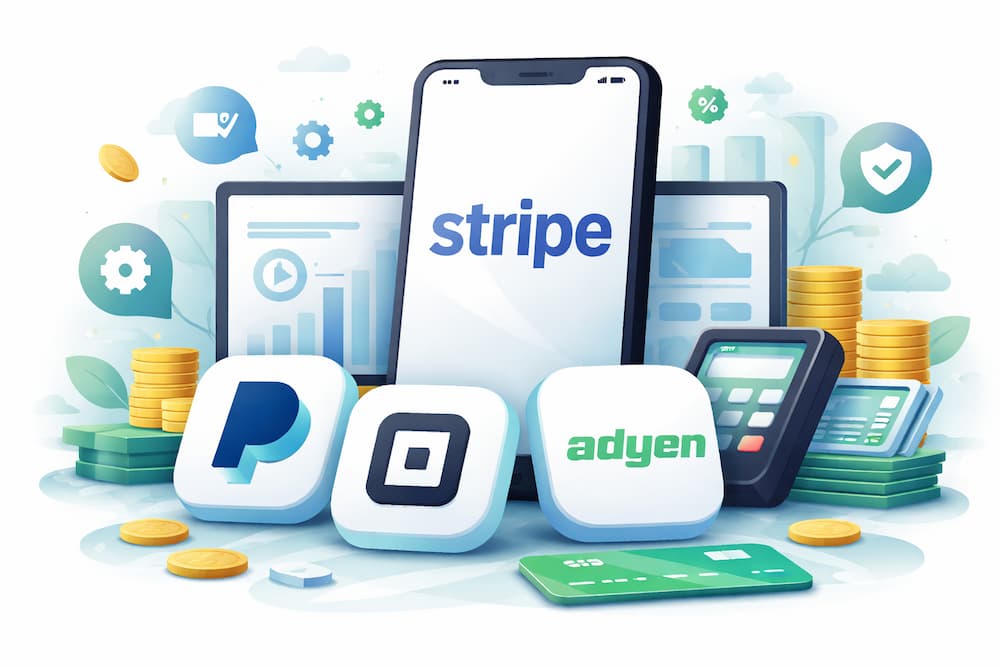
In this post, we have selected the 5 best alternatives based on business type so you can analyze which one best suits you. Let's take a look.
1. RiskPayGo: the leading option in flexibility and withdrawals from $10
We begin the comparison with RiskPayGo, a payment gateway modern designed especially for businesses seeking total freedom and operational simplicity.
Why do we include it in the ranking? Because it stands out for its focus on high flexibility and also accepts payments by card, Google Pay, Revolut, and more, while you receive the money directly in your wallet.
What caught our attention the most is its ultra-low withdrawal policy. Come on, that is to say, that you can withdraw from just 10 USD, with fast and hassle-free processes.
| Pros | Cons |
| Withdrawals from just 10 USD | Less well-known than the major fashion shows |
| High flexibility for high-risk models | Possibly fewer native integrations |
| Quick and easy onboarding | Support may be more limited in some languages |
| Accepts multiple modern payment methods | Rates may vary depending on volume |
| Focus on minimizing declines | Still growing (with a shorter track record) |
2. CCBill: the gold standard for high-risk businesses (High Risk)
If your business is considered high risk, CCBill has been around for more than 20 years being one of the most reliable and specialized options on the market.
Its reputation has been well earned, as it accepts industries that Stripe flatly rejects and for offering high approval rates even with moderately high chargebacks.
But that's not all, as its interface is simple with solid tools for recurring billing, dispute handling, and customized anti-fraud screening. It wouldn’t hurt to try it.
| Pros | Cons |
| Consolidated specialist in high-risk | Higher commissions than standard processors |
| High chargeback tolerance | A somewhat outdated and less intuitive dashboard |
| More than 20 years of experience in the industry | Fewer modern integrations than competitors |
| Good subscription and billing management | Approval process may require more documentation |
| Dedicated support for sensitive industries | It is not the cheapest option for low volumes |
3. Corefy: for companies that need mass payment orchestration
Corefy is not a traditional gateway, but rather a payment orchestration platform (Payment Orchestration).
It allows you to connect multiple payment processors in one place, apply intelligent routing rules, cascading (if one fails, it moves to the next), and optimize costs and approval rates in real time.
With Corefy, you reduce declines, improve conversion, and have full visibility into your entire payments stack from a centralized dashboard.
| Pros | Cons |
| Smart routing and cascading to maximize approvals | Not suitable for small or low-volume businesses |
| Connect with hundreds of PSPs in a single integration | It requires a certain level of technical maturity to get the most out of it |
| Reduce costs and significantly improve conversion | Price depends on the configuration and volume |
| Unified reporting and advanced analytics | Does not act as direct acquirer |
| Excellent for scaling internationally | Initial learning curve |
4. PayPal and Braintree: the classic alternative with the highest consumer trust
PayPal plus Braintree remains a powerful combination. On the one hand, PayPal gives you the immediate trust of millions of users around the world; in fact, many prefer to pay with PayPal rather than with a card.
And on the other hand, Braintree (owned by PayPal) offers you a more advanced and programmable solution similar to Stripe, with an excellent API and support for mobile and web payments.
| Pros | Cons |
| Huge trust and global recognition | Relatively high commissions |
| Strong protection for both buyer and seller | Still strict risk policies in certain niches |
| Braintree offers a very powerful and flexible API | You can freeze funds in cases of high chargeback |
| Easy integration and familiar checkout | Less flexible for clearly high-risk businesses |
| Local payment support in many countries | Withdrawals not as fast as other alternatives |
5. Lemon Squeezy: the ideal solution for selling software and digital products (MoR)
We close the top with Lemon Squeezy, which without a doubt is the favorite option of creators, indie developers, and digital product businesses.
As for its usefulness, it acts as Merchant of Record (MoR), which means that they take care of collecting taxes (VAT, GST, sales tax), handling invoicing and legal compliance in dozens of countries. You only focus on selling.
In addition, it includes automatic license delivery, subscription management, a clean checkout, and tools designed specifically for software, courses, ebooks, and memberships.
| Pros | Cons |
| Merchant of Record: you forget about taxes | Higher commission (around 5% + 0.50 USD) |
| Ideal for digital products and SaaS | Less flexible if you need very specific payment methods |
| Automatic delivery of licenses and files | Dependence on Stripe (after the acquisition) |
| Modern and very easy-to-use checkout | It is not the best option for physical products |
| Perfect for creators and small businesses | Limits in some markets or very high volumes |
How to choose the right payment gateway without dying trying
To choose the right alternative to Stripe, not only should you look for the lowest price. You have to look beyond because cheap can sometimes end up being expensive, and very much so. With this three-step guide you’ll be able to evaluate any option sensibly, without letting yourself be dazzled by marketing.
Analyze the hidden costs
It’s normal that the first thing you look at is the percentage they charge you per transaction. But be careful, because that’s where the story begins, not ends.
Many gateways show you a super-competitive rate, but then they add charges you hadn’t accounted for. And when you add it all up, the “cheap” fee isn’t so cheap anymore.
Before signing, ask these questions:
- Is there a fixed monthly fee, or will I be charged if I don't trade for a while?
- How much does each chargeback cost me? Because if you run a subscription or high-risk business, this can hurt.
- Do I get charged for withdrawing my money? Is there a mandatory minimum?
My advice is that you ask for a simulation with your real volume, so that way you see the full cost, not just the nice percentage they put on the home.
Check the API and the integration (because if it's a mess, you'll want to kill yourself)
Here is an uncomfortable truth, and that is that many gateways have an API that looks like it came straight out of the 90s. And if your technical team takes weeks to get something working that should be ready in days, you're losing time and money.
If you use platforms like Shopify, WooCommerce, or have a custom development, pay attention to two things.
First, that the API documentation is clear and up to date, not a three-year-old document full of holes. Second, that they have a test environment (sandbox) where you can try things without fear before jumping into the ring.
And ask directly: how long does a real integration usually take for my type of business? Do you provide technical support during the process, or do you just send us a manual and leave us to it? Trust me, good support during the integration phase can save you weeks of frustration.
Verify PCI security and data handling (this is not optional)
You may not like to think about this, but it is more important than the commission they charge you. If your payment gateway doesn’t properly handle your customers’ data, you expose yourself to fines, blocks and, worst of all, losing the trust of those who buy from you.
Make sure they comply with PCI DSS Level 1, which is the highest standard in payment security.
Also review how they handle tokenization (the part about storing card data without you having to deal with sensitive information), what anti-fraud tools they have, and how they protect you against chargebacks.
What is the best alternative to Stripe for your brand this year?
After analyzing flexibility, fast withdrawals, risk tolerance, and real user experience, RiskPayGo positions itself as the best alternative for most businesses who are seeking operational freedom in 2026.
With withdrawals starting from just 10 USD, streamlined onboarding, strong acceptance for high-risk business models, and a practical focus on keeping cash flow healthy, RiskPayGo gives you the flexibility that Stripe often restricts, without unnecessary complications.
Frequently Asked Questions
What is the best alternative to Stripe if my business is high-risk (High-Risk)?
If you sell products or services that Stripe usually rejects, the strongest option is RiskPayGo, which allows fast withdrawals from $10 and native support for cryptocurrencies.
Which payment gateway allows you to charge in countries where Stripe is not available?
For entrepreneurs in Latin America or regions with banking restrictions, Corefy and RiskPayGo are excellent alternatives, because these platforms work as orchestrators or global gateways that do not depend on Stripe’s physical infrastructure.
Are there alternatives with lower fees or without fund holds?
Although fees depend on volume, RiskPayGo offers you greater transparency in cash flow, with more human verification processes that prevent the automatic blocking of funds by algorithms.