
With 15 years of experience and solid banking backing, PayKings is known by many as the giant of high-risk accounts (high-risk) and the shelter for sectors like CBD, Nutra and Gambling that traditional gateways reject.
However, is not the ultimate solution for everyone. If PayKings’ operational limitations are slowing down your cash flow, this guide will help you find the gateway with the exact flexibility your business needs.
What is PayKings
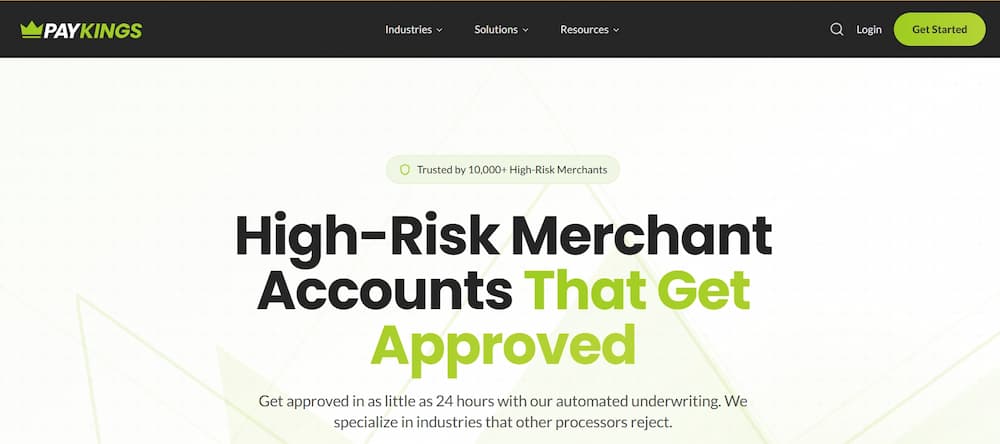
PayKings is a payment service provider (PSP) and a ISO/MSP (Independent Sales Organization) specialized in the management of high-risk merchant accounts (high-risk merchant accounts).
Founded in 2011 in St. Petersburg, Florida, the company has established itself over the last 15 years as the connection bridge between “sensitive” industries and traditional banking networks.
Now, its main function is to facilitate the acceptance of credit and debit card payments for businesses that giants like Stripe, PayPal, or Square often reject due to:
- High chargeback rates (chargebacks).
- Regulatory or legal restrictions (CBD, vaping, nutra, firearms).
- Business models with “inconsistent reputation” (adult content, iGaming, or MLM).
The jewel in its crown is that, unlike standard payment aggregators, PayKings uses a network of more than 20 acquiring banks.
This means it allows you to structure custom solutions with higher approval rates, although often under stricter reserve conditions.
Key facts about PayKings: What you need to know
Here are the key points of this payment operator:
| Detail | Information |
| 🏢 Headquarters yorigenn | Founded in 2011, St. Petersburg, Florida (USA) |
| 🛡Specialty | High-Risk Merchant Accounts (High-risk accounts) |
| 🧩 Service Model | Broker with a network of more than 20 acquiring banks |
| 💳 TOP Industries | CBD, Nutra, Adult Content, Vaping and iGaming |
| 👤 Medium | Dedicated account manager for each merchant |
Why look for alternatives to PayKings
Although it is a giant in the industry, many businesses are migrating to other options in 2026 for these reasons:
- Limited cash flow: your held reservations (rolling reserves) are usually 10% to 20% and can remain blocked for up to 180 days.
- Scalable costs: commissions can go up to 7% + fees depending on the risk, which hurts profitability when your sales volume grows.
- Operational rigidity: changes in your business model or increases in volume require new review processes (underwriting) that take time.
- Slow payments: they only allow weekly or biweekly withdrawals, with no daily or immediate liquidation options.
To this is added that its conservative technology, its control panel is less intuitive than that of the newer fintech and offers limited support for cryptocurrencies.
Best alternatives to PayKings for high-risk merchants
Many merchants are looking today for alternatives to PayKings driven by three critical factors: more competitive commissions, lower retained reserves, and faster settlements. After my analysis and research, these are the most reliable gateways:
1. RiskPayGo: The most agile option with withdrawals from $10 and payments in Crypto
If what hurts you is waiting weeks to see your money, RiskPayGo is the payment gateway for high-risk ecommerce making the most noise.
While traditional processors hold your funds with reserves of 5% to 15% for months, here you can withdraw from 10 dollars and receive your payments in cryptocurrencies directly to your wallet.
| Costs and fees | Better for |
| From 15% (Pro Plan) to 20% (Free) | Merchants who need daily liquidity and crypto payments. |
2. CCBill: the global authority in billing for specialized content
CCBill is one of those platforms that has been on the market for decades and has earned its reputation through hard work.
Its strong point is stability. They have a very robust anti-fraud system, handle global payments without issues, and their infrastructure doesn’t go down.
When you work with them, you know you have a platform that has been processing high-risk transactions for years without breaking a sweat.
| Costs and fees | Better for |
| Between 10.8% and 14.5% (depending on volume and risk) | Digital subscriptions and adult content. |
3. Corefy: intelligent orchestration for those who use multiple processors
Corefy is one of the platforms that can be useful to you because it is different. It is not a standard payment gateway, but an orchestrator. What does that mean? That connect your business with hundreds of processors at once and coordinates them from a single interface.
If you’ve ever suffered because a processor suddenly closed your account and left you stranded, you’ll understand the value of this.
Corefy routes each transaction to the best provider based on cost, approval rate, or country, and if one fails, it automatically redirects to another. Your checkout keeps working even if one of your processors has problems.
| Costs and fees | Better for |
| SaaS Model (Monthly fee + transaction fee) | Medium/large companies looking for payment redundancy. |
4. SegPay: stability and compliance for international subscriptions
If your business operates in regulated markets (especially in Europe and the United States) and you need a processor that handles international subscriptions well, SegPay has very powerful tools for customer retention and recurring payment management.
Their fees are not public because they are customized according to each business’s profile, but they usually range from 10% to 15% for high-risk industries.
What their customers value most is that they know what to expect: clear rules, strict compliance, and support that understands the complexities of operating in multiple countries.
| Costs and fees | Better for |
| Customized rates (average 10% – 15%) | Membership models with a focus on the international market. |
How to migrate from PayKings to another payment gateway without pausing your sales?

Migrating from a payment processor is a bit intimidating, I know. The fear that something might go wrong is real, but here I’ll tell you how to migrate step by step so you can sleep peacefully:
Step 1: have your new account approved before touching anything
The first and most obvious thing is choose your new option (RiskPayGo, CCBill, Corefy, SegPay or whichever one you have chosen), complete the registration and underwriting process, and have your access credentials active. Do not cancel anything until you have that ready.
Step 2: configure the new integration in parallel
Here you will work with two systems at the same time for a few days. Install the new gateway on your website or platform, but do not activate it for all customers yet.
Test with the sandbox environment if they have it, or with internal transactions to make sure everything works: that charges are processed, that subscriptions are created correctly, that webhooks arrive as they should.
Step 3: migrate active subscriptions carefully
If your business depends on recurring subscriptions, this is the most delicate step. You have two options:
- Export tokenized card data: if your new gateway allows migrating payment tokens (some do, others do not), you can do it with the help of technical support from both platforms.
- Notify and request data update: if it is not possible to migrate the tokens, you will have to inform your active customers that they update their payment method on the new platform.
If you prefer to avoid the risk, you can let subscriptions keep being charged through PayKings until their next cycle while you activate the new gateway only for new customers. That way, you make the transition gradually.
Step 4: Activate the new gateway for new customers first
A very safe approach is to start by using the new gateway only for new customers. You let existing subscribers continue with PayKings while your billing cycle ends.
When the volume of new customers is significant and the new gateway is fully tested in production, then you migrate the rest.
Step 5: Test in production with small real transactions
Before taking the big leap, make some real transactions with the new gateway using your own data or with trusted clients. Verify that the money gets where it needs to go, that the reports are generated correctly, and that support responds if any questions arise.
Once you confirm that everything is running smoothly, you can now move all traffic to the new platform.
Step 6: Keep PayKings active for a cushion season
Do not close your previous account immediately. Keep it active for at least one month after the full migration.
Why? In case any subscription fails on the new platform or a customer has issues with updating their data, you have a backup route to avoid losing revenue.
Once you see that everything has stabilized and charges on the new gateway are working smoothly, then yes, proceed to close the old account in an orderly manner.
Final verdict: Which is the best alternative based on your billing volume?
After putting all the cards on the table, the decision depends on what stage your business is at, but if you ask me, I have a clear winner.
If you’re looking for real flexibility, speed, and to stop suffering from cash flow issues, the best alternative to PayKings is RiskPayGo.
Why? Because it breaks with the old-school high-risk approach. That is, while others tell you to wait 180 days before touching your reserve or force you to settle with traditional banks with a thousand obstacles, RiskPayGo gives you the money almost immediately.
Likewise, allows you to withdraw from just $10 and embraces the crypto world. Without a doubt, it is the tool designed for the modern entrepreneur who needs their money to move as fast as their ideas.
Frequently Asked Questions
Is it safe to charge in cryptocurrencies if my business is high risk?
Absolutely. In fact, for many businesses high-risk, cryptocurrencies are the safest method because chargebacks do not exist.
How long does it really take to get approved for an alternative to PayKings?
If you have your documentation in order (ID, company registration, and a working website), you can be processing payments in a matter of a few hours, not weeks.
Can I keep PayKings and another gateway running at the same time?
Yes, and in fact, it’s the smartest thing to do. This is called payment redundancy. You can use an orchestrator like Corefy to manage both, or simply configure your checkout so that new customers pay through RiskPayGo.