
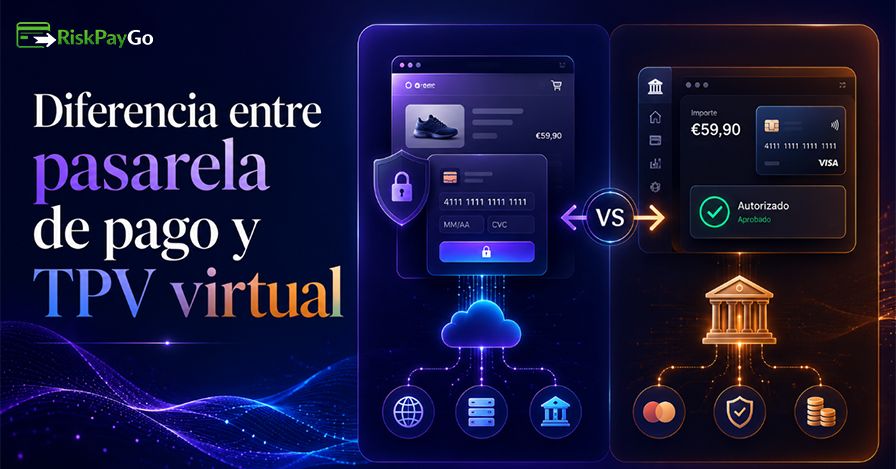
What is the difference between a payment gateway and a virtual POS terminal? There are many, and they really matter.To begin with, a payment gateway is an external system that connects your website with multiple banks and payment methods, while a virtual POS terminal is a tool that your own bank provides to accept card payments online.
In Spain, according to the Baymard InstituteWhen the payment system fails, the average cart abandonment rate in 2026 is 70.22%, although in many sectors and especially on mobile it easily exceeds 75%.
Therefore, what happens behind the button "pay" It matters more than it seems. And to optimize it properly, first You need to understand what you're working with.That's exactly what we're going to solve in this master guide.
First: why everyone confuses them (and why it matters to distinguish between them)
The root of the problem is historical. For years, the virtual POS terminal was the only system that banks offered for online payments. And the catwalk was a technical concept that remained in the background, invisible to commerce.
Basically, the bank gave you the POS terminal, charged you a monthly fee, and that was it: you had online payments.
Over time, the payments ecosystem became more sophisticated, and independent providers, digital wallets, Bizum, payment links, and subscription models emerged. Banks were no longer the only option.
And in that process, the terms became mixed up until today it is almost impossible to ask: Do I need a POS or a gateway? without being answered with another question.
Why is it important to understand the difference between a POS terminal and a payment gateway?
The distinction matters for a very simple reason: If you only contract a bank virtual POS terminal, you will only be able to accept card payments..
But if you set up a complete payment gateway with all methods integrated, you can accept card payments, Bizum, PayPalWallets, transfers, and whatever else comes along. And that difference, in terms of conversion, is enormous.
What is the difference between a payment gateway and a virtual POS terminal?
The direct answer is that The virtual POS is the channel and the gateway is the infrastructure. Let's analyze it point by point.
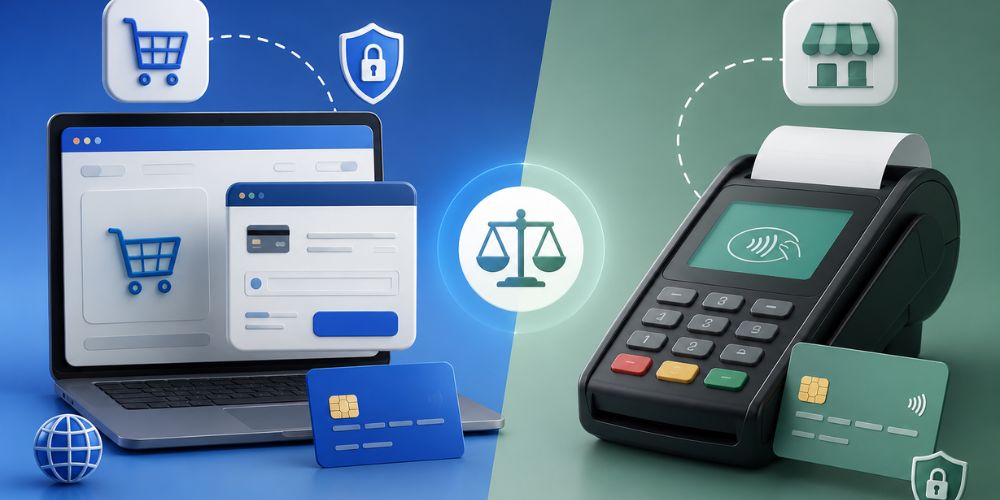
As we've been telling you, The POS system is the system that collects the data from your customer's card and sends them to the bank to approve the payment.
It's like the digital version of the card reader you find in any physical store. It works well, it's secure, and it's still the most widely used payment method. But it only does one thing: accept card payments.
The payment gateway, on the other hand, is the complete ecosystem that connects your store with payment processors, banks, and the various collection methods available.
The virtual POS terminal can be one of those methods, but so can Bizum, PayPal, Apple Pay, Google Pay, BNPL or bank transfer payments, since the gateway integrates them all, routes them intelligently and manages the security of each transaction.
Quick summary of their differences
| ⚡ Key differences | 🏦 TPV virtual | 💳 Payment gateway |
| Main function | Process the payment with the bank | Connect and authorize the transaction |
| Bank branch | Yes, usually linked to a bank | It doesn't always depend on a bank |
| Integration | More technical and limited | More flexible and easier |
| Payment methods | Cards mainly | Tarjetas, wallets, Bizum, Apple Pay, etc. |
| User experience | More basic | More optimized and modern |
| Security | It meets banking standards | It includes advanced anti-fraud tools |
| Personalization | Limited | High customization |
| Costs | Bank fees | Transaction and service fees |
What is a payment gateway and what exactly does it do?
The payment gateway is a system that encrypts customer data, selects the best route to process the transaction, It communicates with the issuing bank and returns an approval or rejection response, all in less than three seconds.
It also manages retries when a transaction fails, applies real-time anti-fraud rules, and in many cases analyzes transaction behavior to decide whether to request additional authentication (3D Secure) or let it pass smoothly.
Payment methods that a payment gateway can handle
This is the difference that has the greatest impact on the business. A well-configured gateway can manage:
- Credit and debit cards (Visa, Mastercard, Amex).
- Bizum which is the fastest growing mobile payment method in Spain.
- Digital wallets: Apple Pay, Google Pay, Samsung Pay.
- PayPal and similar solutions.
- BNPL (Buy Now Pay Later): Klarna, Scalapay, Sequra.
- Payments via link, QR code or transfer code.
- Instant bank transfers (SEPA).
- Local and international methods depending on the market where you operate.
The virtual POS only covers the first step. For everything else, you need the payment gateway.
What is a virtual POS terminal and how does it differ from a physical card reader?
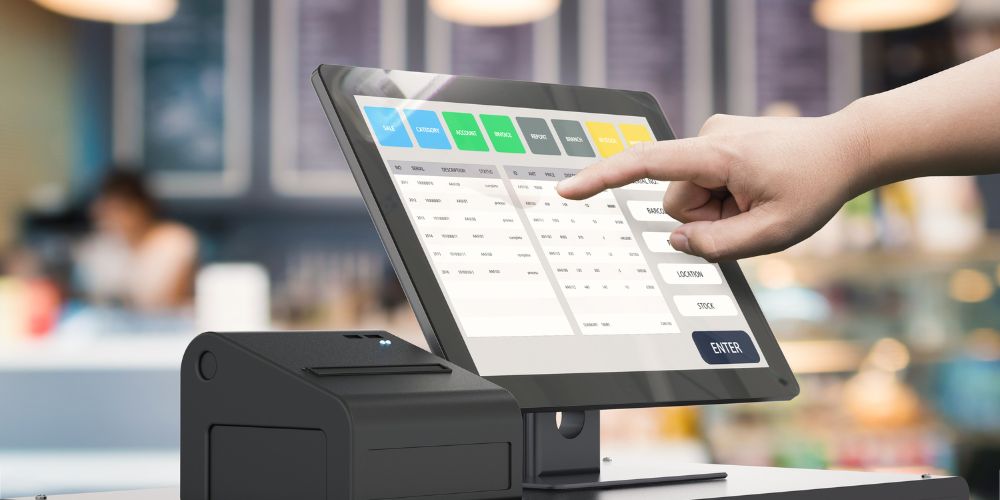
The virtual POS is like the card reader for your online store. In fact, it's the point of sale that allows you to collect payments without wasting time. Through a digital form, the customer enters the card number, expiration date, and CVV.
Without it, you can't accept card payments online, but with it, you can. And that's all there is to it. Nothing more, nothing less.
Does the virtual POS terminal belong to the bank or the payment gateway?
The answer is: it can be either one.
- Scenario 1: You contract a virtual POS terminal directly with your bank. The bank assigns you credentials (merchant number, access code) that you connect to your payment gateway so that it knows how to route card payments.
- Scenario 2: You contract a payment gateway with an independent provider that already includes its own integrated virtual POS module. One contract, one control panel, and the provider manages the relationship with the acquiring bank for you.
More and more businesses are opting for the second option because it greatly simplifies operations. However, for businesses with very high volumes, negotiating the POS terminal terms directly with the bank can be more economical.
Which one does your business need?
The truth is that, in order to accept all types of payments, You need both a gateway and a virtual POS terminal. since each of them has its own functions and when integrated they expand the reach of your business.
However, traditional banks and many standard payment gateways either outright reject these sectors or accept them with such restrictive conditions (retained reserves, low volume limits, high fees) that they become impractical.
For this profile there is RiskPayGo, a catwalk specifically designed for high-risk businesses. It has a faster onboarding process than a bank, smart routing, and payouts in USDC, something that conventional banks do not offer.
If your industry has been rejected by your bank or standard payment gateways, the problem isn't your business. It's that you're knocking on the wrong door.
Frequently Asked Questions
Are a virtual POS terminal and a payment gateway the same thing?
No, although they are often used interchangeably. A virtual POS terminal is the system that processes card payments, while a payment gateway is the ecosystem that integrates multiple payment methods, including the virtual POS terminal as one of them. They are complementary.
Can I have a payment gateway without contracting a POS terminal with my bank?
Yes. If the payment gateway provider you choose includes its own integrated virtual POS module, you don't need to sign anything with your bank to accept card payments. The provider manages the relationship with the acquiring banks for you.
Which is cheaper: the bank's POS terminal or an independent payment gateway?
It depends on the volume. For low volumes (less than €5,000/month), a standalone payment gateway without a fixed fee is usually cheaper because you only pay when you receive payment. For high volumes, with good negotiation, a bank-run POS terminal with a reduced commission can be competitive.
Does the payment gateway work for in-person payments as well?
Yes, the most complete payment gateways support omnichannel: you can collect payments on your website, from the app, via payment link sent by WhatsApp, by QR code, by phone, and in physical stores using integrated terminals.
What happens if my bank rejects my virtual POS terminal application because of my business sector?
Being rejected by the bank doesn't mean you can't operate; it means you need a provider specializing in your industry. RiskPayGo, for example, works specifically with sectors that traditional banks classify as high-risk, offering a faster onboarding process and terms tailored to that reality.
How long does it take for each system to become operational?
A bank-issued virtual POS terminal can take between two and six weeks to set up, depending on the bank and the required documentation. A payment gateway with an independent provider can be operational in 24 to 72 hours in many cases.