
The moment of payment is the now-or-never of your online business. Even if you have amazing products, the 70% of carts are abandoned (according to Baymard Institute) due to complex or unreliable processes.
That's why, knowing what a payment gateway is and how it works will be a good strategy. In fact, in 2025, this market reached 30.58 billion dollars, and Fortune Business Insights data project that it will grow at an annual rate of 12.78% through 2034.
But how does this really work so that your business sells more? I explain everything in today’s article.
What is a payment gateway?

A payment gateway is the technological system that acts as a secure bridge between your online store and banks or financial institutions.
What characterizes it is that it allows the customer to enter their payment details and complete the transaction in a matter of seconds, without you having to handle the sensitive card information directly.
On the other hand, the INCIBE highlights its role as a digital intermediary, since when the buyer clicks “pay,” the payment gateway encrypts the data, sends it to the corresponding processor, and returns an almost immediate confirmation.
All this happens in the background, invisibly to the user, but with a very high level of security.
Importance of the payment gateway for your online store
The importance of the payment gateway for your online business is enormous. Imagine that you’ve done all the hard work: impeccable design, top products, and effective advertising. The customer gets to the cart, but at the very last second, leaves—and it’s not an isolated case.
According to the Baymard Institute, the average cart abandonment rate is close to 70.22%. The reason? Slow processes, lack of payment methods, or distrust.
An excellent payment gateway not only moves money, but also It is the tool that breaks down the final barriers between your product and your client's bank account.
Goodbye to friction: more options, more sales
Nowadays, forcing someone to take out the physical card can be a mistake, since what today’s customer is looking for is convenience, and by integrating a robust payment gateway, you offer:
- Digital wallets: Apple Pay and Google Pay to pay with a tap.
- Local methods: Bizum or PayPal, which convey immediate trust.
- Flexibility: "buy now and pay later" options for high-value orders.
Invisible security (but impenetrable)
Security is non-negotiable. A professional gateway takes care of all the legal and technical dirty work that you do not want to (nor should you) handle manually:
- PCI DSS Regulations: compliance with global security standards.
- Data encryption: protect the buyer's sensitive information.
- Fraud detection: systems that analyze risks in real time to prevent chargebacks.
Operational agility for your day to day
Beyond the sale, an efficient payment gateway gives you back time, while allowing you to manage your business professionally with fast settlements, good automations, and a smooth checkout that turns visitors into loyal customers.
The impact of a good choice
| Factor | Without an efficient payment gateway | With a Pro payment gateway (such as RiskPaygo) |
| Abandonment rate | Superior to the 70% due to distrust. | Minimal, thanks to a fast and secure flow. |
| Payment methods | Limited to traditional card. | Multichannel (Bizum, Wallets, Crypto). |
| Fraud risk | High, no active protection. | Total shielding and preventive detection. |
| Management | Manual and slow processes. | Total automation of charges and credits. |
How a payment gateway works step by step (from when the customer pays until you receive the money)
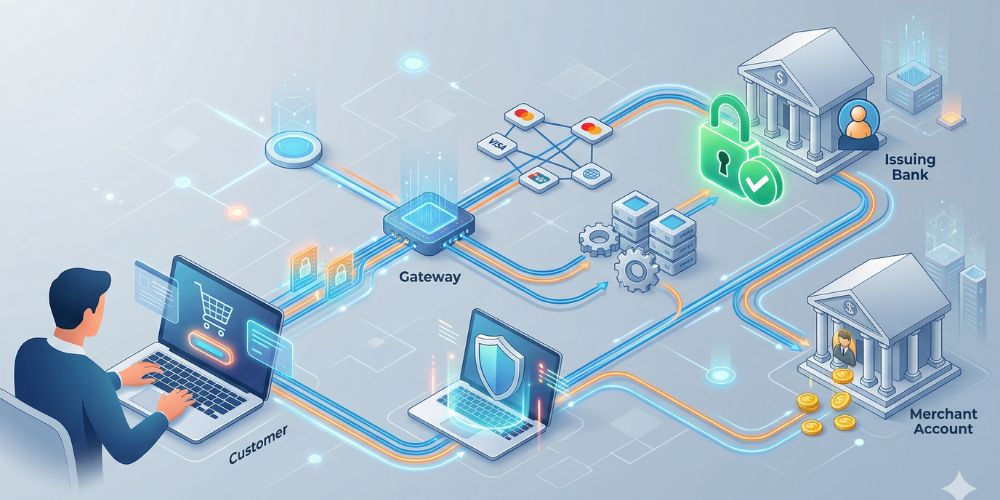
It’s not magic that a payment gateway does, but rather the exchange of encrypted data. In other words, when your customer clicks “Pay,” a security protocol is activated that follows these steps:
Step 1: capture and shielding (data encryption)
As soon as the customer enters their card details, the payment gateway kicks in. Its first mission is to encrypt and tokenize the information. The card numbers are converted into a unique code, a token, that travels securely without exposing the real data.
Step 2: Authorization request
Here the gateway sends that data to the payment processor, which in turn contacts the card network (Visa, Mastercard, etc.) and the customer's bank.
At this moment, two key questions are asked: “Does it have sufficient funds?” and “Is this transaction secure?” This is the moment for 3D Secure, where the customer usually confirms the purchase from their bank app with a code or fingerprint.
Step 3: the verdict (approval or rejection)
The customer’s bank gives the “OK” or the “No.” This response returns the same way in milliseconds. If approved, the gateway tells your WooCommerce: “Sale completed, you can prepare the order.”
And keep in mind, at this moment the money is still not in your pocket, but it is already locked and guaranteed for you. The sale is yours.
Step 4: the deposit into the trading account
One thing is for the sale to be approved, and quite another for the money to appear in your bank statement. This is where many entrepreneurs become impatient.
The money travels from the client's bank to your merchant account, which is the internal account you have within the gateway itself.
Step 5: the final transfer to your bank (payout)
Depending on the payment gateway you choose, this step can take from 24 hours to 7 days. For example, Stripe or PayPal usually have fixed T+2 or T+3 cycles, that is, two or three days after the sale.
Types of payment gateways
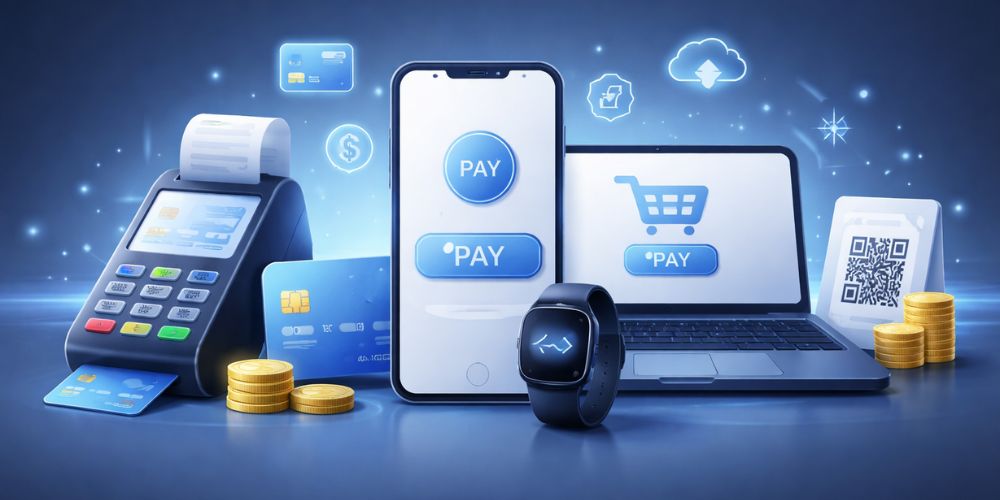
At this point in the post, you need to know that not all gateways are the same or serve the same purpose. Depending on your business, one type or another may be of interest to you:
Integrated gateways
Also called all-in-one, these include their own billing account, and with them you do not need to contract a separate bank. Examples of them are Stripe, PayPal, MONEI.
- Advantage: you activate them in minutes, without bank paperwork.
- Disadvantage: they can withhold your money if they detect «risk».
- For whom: small or medium businesses that are starting.
Gateway payment processors only (you need a bank account)
These only process the payment, but the money goes directly to your bank account, so they do not hold funds. Examples: Redsys, Sabadell TPV Virtual.
- Advantage: the money arrives directly, without intermediaries to hold it back.
- Disadvantage: you need to contract a POS with your bank, more paperwork.
- For whom: businesses with stable volume and a business bank account.
High-risk payment gateways
Specialized in sectors that Stripe or PayPal reject, such as supplements, vaping, adult content, crypto, forex. An example of this type of payment gateway is RiskPayGo, which is a gateway for high risk.
- Advantage: They approve businesses that others ruthlessly reject.
- Disadvantage: slightly higher commissions (18%-20% vs 2.9% for Stripe).
- For whom: businesses in problematic sectors or with high chargeback.
Omnichannel gateways (online + physical)
These are the ones that unify online store and physical POS payments in a single panel, where the best-known are PaynoPain (Paylands) and Redsys.
- Advantage: you manage everything from the same place.
- Disadvantage: integration is usually more complex.
- For whom: hybrid businesses that sell online and in-store.
How to choose the best payment gateway for your business
To choose the most suitable payment gateway for your business, you need to focus on these four elements:
What sector do you sell in?
This is the first thing you should analyze and the one that removes the most filters. Keep in mind one thing: if you sell high-risk products or services, such as supplements, vaping, adult content, crypto, forex, replicas, etc., forget about Stripe and PayPal. They will close your account sooner or later.
Your only real option is high-risk gateways like RiskPayGo. But if you sell regular products, then Stripe, PayPal or Redsys are valid options.
How soon do you need the money?
You must choose a payment gateway that gives you the money as soon as possible. Traditional gateways like Stripe or PayPal work with fixed cycles: T+2, T+3, or even longer if they detect suspicious behavior.
Meanwhile, high-risk gateways like [insert gateway name here] give you much faster liquidity, sometimes in 24 hours or with instant crypto payments.
Where are your customers?
For sales in Spain, a local payment gateway like Redsys or MONEI will work well for you and will accept Bizum, which is key here.
Now, if you sell across all of Europe, you need something like Stripe or PayPal that handles multiple currencies and international payment methods. If you sell globally (the U.S., Latin America, Asia), Stripe is the most reliable, although be careful about its country restrictions.
How much are you willing to pay in commissions?
Commissions are not just the percentage they take from each sale. There are more hidden costs. In my research, I verified that traditional payment gateways (Stripe, PayPal) charge between 2.9% and 3.5% plus a fixed fee.
However, high-risk payment gateways charge between 18% and 20%, but they allow you to operate where others do not. Bank gateways (Redsys) usually have lower fees (1.5%-2%), but they charge you a monthly or maintenance fee.
Therefore, do the math. If your margin is 10%, you can’t afford a payment gateway that takes 18% from you. But if you have no other option because your sector is high risk, accept it as the cost of being able to charge.
The extra question: What happens if my account gets blocked?
There are stories of people who had been with Stripe or PayPal for years and one day, without warning, they froze their funds for 180 days.
That's why many high-volume businesses use two or three payment gateways simultaneously, one as the primary gateway and the other as a backup. This way, if one fails, you can still collect payments through the other.
What is the best payment gateway for high-risk businesses?
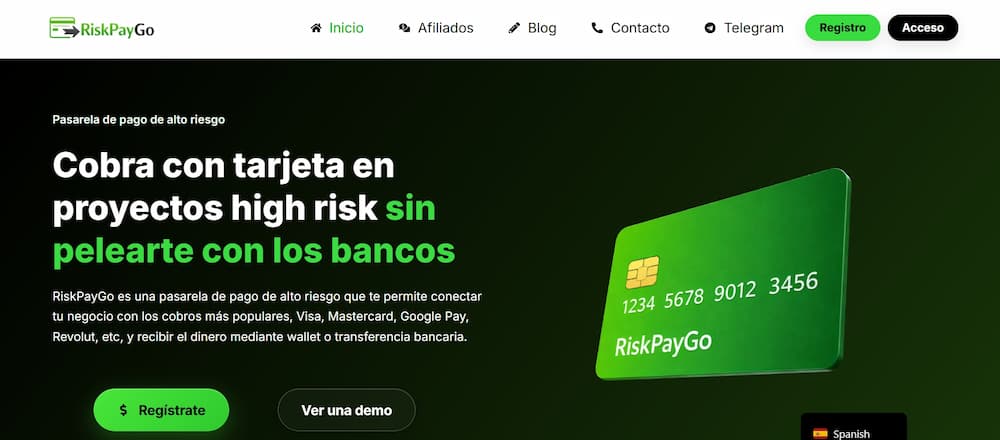
For businesses operating in risky sectors, the best option on the market is RiskPayGo, since, unlike Stripe or Redsys, this gateway has built its model specifically to serve businesses considered high risk.
In addition, its approval process is agile, its settlements are faster, and it offers the possibility of operating with stable cryptocurrency (USDC), completely eliminating the risk of chargebacks.
Frequently Asked Questions
¿Do I need a payment gateway to sell online, or can I charge in another way?
If you want to sell professionally and build trust, yes, you need a payment gateway. Although alternatives such as bank transfers or manual payments exist, they create friction, reduce conversion, and can cause you to lose sales.
What is the difference between payment gateways and a payment provider?
Although they are often used as synonyms, they are not exactly the same. The payment gateway is the technology that connects your store with the customer's bank to process the transaction, while the payment provider is the company that manages the entire service (payments, settlements, security, etc.).
Which payment gateway is best for starting an online store?
It depends on your type of business. If your business is standard, you can opt for popular solutions. If you operate in more complex or high-risk sectors, you will need a specialized payment gateway that does not limit your payments or block your account.