
Do you know what VisaNet is? Don't worry, I didn't either until recently. It's the Visa payment gateway, which connects the millions of cardholders who use this provider's service worldwide.
Actually, according to the Visa Annual Report 2025, This payment gateway processes over 257.5 billion transactions per yearConnecting nearly 5 billion credentials with over 150 million businesses in more than 200 countries.
In the following sections, I'll explain how you can accept payments with Visa payment gateway in your digital business, and you'll even see what other options you have depending on the risk level of your business.
What is the VISA payment gateway?
The Visa payment gateway is not exactly a traditional platform like those of Stripe or PayU. Actually, VisaNet is Visa's global payments network.
In other words, it refers to the technological infrastructure that acts as the bridge which makes it possible for any Visa card to work at any merchant in the world.
Think of it as the central nervous system of Visa payments. It doesn't issue cards (banks do that), but rather connects:
➡️5 billion digital cards and credentials.
➡️150 million businesses.
➡️Thousands of banks in 200 countries.
To give you an idea: in 2025, VisaNet processed more than 257.5 billion transactions, and all of that with a reliability and security that very few systems in the world can match.
What does this mean for your business?
When you integrate Visa payments (directly or through a provider), you are connecting to that immense network which, by the way, is one of the largest in the world.
Besides, Gain global reach, massive acceptance and, incidentally, the trust that customers associate with the Visa brand.
How a Visa payment gateway works behind every purchase
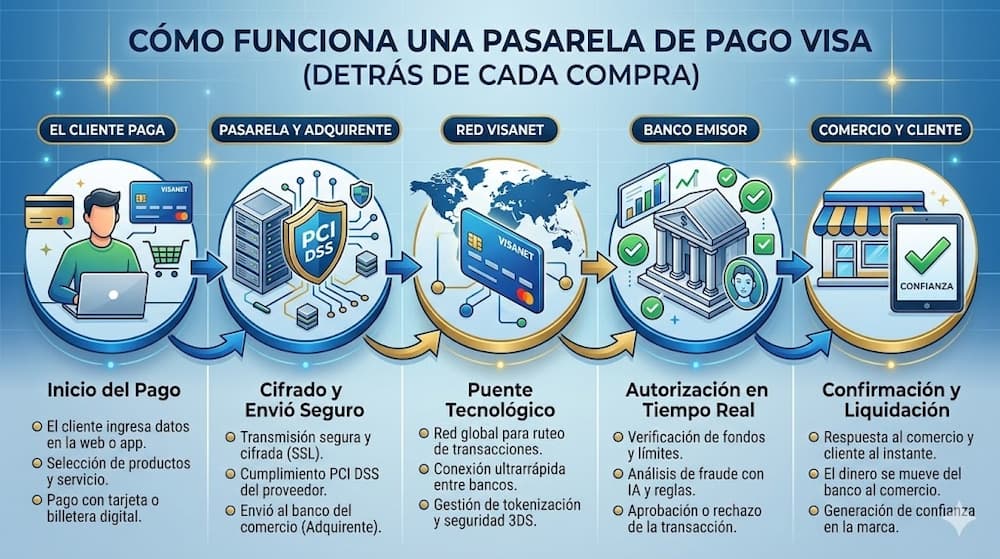
For the customer, the Visa payment gateway is magic: pay in two seconds and that's it. But behind the scenes, there's a fast, highly structured, and quite interesting process:
1. The customer initiates the payment
First, the person who is going to pay enters their data on your website, app or terminal (or pays with Apple Pay, Google Pay, etc.).
2. Encryption and secure delivery
Then, your gateway or integration encrypts that information and sends it to the merchant's bank (acquirer).
3. Get to VisaNet
This is where the network shines, as it routes the request to the customer's bank (issuer) in milliseconds.
This step involves tokenization (the actual card number is not sent) and 3D Secure rules (to verify that it is the legitimate holder).
4. Real-time authorization
Next, the customer's bank checks the balance, limits, and suspicious activity (this is where Visa's AI comes in) and responds: approved or declined. VisaNet acts as the ultra-fast messenger between the two banks.
5. Confirmation to the client
Finally, the response returns along the same path and the client sees the result on screen. All in less time than it takes to blink.
Later (usually at the end of the day) settlement occurs, which is where the real money moves from the customer's bank to yours, minus fees.
An interesting detail about the payment process
Thanks to VisaNet + artificial intelligence, today Real-time patterns are analyzed to detect fraud before it happens.
What you see as a sale in seconds, the system processes hundreds of variables in real time. That's why Visa's fraud rates are historically low.
What does a business need to start accepting Visa payments?
If you've made it this far, you're probably wondering: How do I start accepting Visa at my business?
The good news is that it's easy, since you don't need to talk to Visa directly. As we mentioned, they have a huge network (VisaNet), but You connect through an intermediary.
In other words, you can do it through an acquiring bank, which can be your usual bank or a specialized one, or even through a payment service provider (PSP) like Stripe, Niubiz, PayU, Mercado Pago, or another. payment gateway reliable.
Your job is to choose the right partner, while theirs is to connect you to the whole system.
✅ Basic requirements (updated to 2026)
Next, I'll explain what you should have on hand. But don't worry, most businesses already have this; it's just a matter of keeping it organized.
Legal documents for your business
You need to have your RFC and RUT updated. Articles of incorporation, etc. In other words, the document that proves you legally exist.
You will also need to have a visible business name, physical address, phone number and website, as Visa requires more clarity in bank statements to avoid claims.
Business bank account
Another requirement is to have a bank account in the name of the company, since that's where you'll receive the money from the sales (usually in 1 to 3 business days).
Security: the famous PCI DSS
Yes, I know this sounds technical, but if you use a modern provider and don't store card data on your server, you're already ahead. Most PSPs handle it for you. In other words, you have to comply with card industry security standards.
Risk assessment (underwriting)
The supplier will review:
- What do you sell (some businesses like gambling or CBD require more requirements).
- How much do you expect to sell?
- Your credit history (if applicable).
It will also check that you have clear refund and shipping policies on your website.
Technical integration
For the integration of the Visa payment gateway, you need the following elements:
- OnlinePlugin (WooCommerce, Shopify), API, or hosted checkout.
- Physical: Terminal POS, datáfono o Tap to Pay.
In addition, you are required to have support for 3D Secure, tokenization, and contactless payments.
🚀 Recommended steps to get started (no fuss)
This is a summary of the integration roadmap. Take a look:
| Passed | Key action | What should you do? | ⏱️ Time / Approximate cost |
| 1. Choose a supplier | Compare options | Evaluate fees, money settlement times, and the quality of local support. | Cards: 2.5% – 3.9% + VAT per transaction. |
| 2. Request an account | Send documentation | Request your account merchant (commerce) delivering the legal requirements of the business. | From a few hours to 1 week. |
| 3. Technical integration | Run tests | Connect the gateway to your platform and test the flow in mode sandbox (fictitious money). | It depends on the technical equipment (hours/days). |
| 4. Launch | Activate and signal | Activate real payments, train your team, and Place the Visa logo visible on your web/local device. | Immediate (Generates instant trust). |
What should a good Visa payment gateway have to avoid hindering your conversions?
A good integration with the Visa network is designed to make the purchase process frictionless for the customer. Today, with shopping cart abandonment rates nearing 70% in e-commerce, every second and every extra complication counts.
Therefore, an optimized gateway can recover a significant percentage of those lost sales if it offers these elements:
- Extreme speed and simplicityThe payment process must be completed in a few clicks and must have native support for Apple Pay, Google Pay, and click-to-pay.
- Multiple methods and flexibilityA good solution includes digital wallets, BNPL (buy now, pay later), and local options depending on your market.
- Frictionless safety: that it has tokenization, intelligent 3D Secure (which no longer asks for unnecessary passwords in many cases) and biometric authentication.
- Mobile adaptability and unified experience: Over 50-60% of online purchases are made on mobile devices. The payment gateway must be responsive, fast, and consistent, without redirects that generate distrust or slow down the process.
But the real gem is its complete transparency and fault recovery capabilities. In other words, it should be able to show full costs from the start and provide clear and helpful error messages.
Advantages (and disadvantages) of working with the Visa global network
Now, connecting with VisaNet gives you access to a proven, globally recognized infrastructure. But that's not all; it also has other advantages and disadvantages that you should be aware of:
🟢 Advantages of working with Visa
- It allows access to billions of users who buy with complete peace of mind when they see the logo on your website.
- It offers high speed and approval processing international payments in milliseconds and with a minimal rejection rate.
- It features advanced security which reduces fraud and headaches through intelligent real-time detection tools.
- Are scalability and modernity They allow you to integrate digital wallets like Apple Pay and grow without needing to change your infrastructure.
- It provides a strong brand prestige that projects instant professionalism and helps you compete with the big players in the market.
🔴 Disadvantages to consider
- It has higher fees than local networks or alternative methods.
- There is a dependence on intermediaries, since you do not connect directly to Visa.
- It presents a significant risk of chargebacks due to its policies.
- It offers less local flexibility by ignoring regional wallets or systems.
The future of payments: less friction and more smart authentication
As you can see, The global trend points towards systems that validate the buyer's identity invisibly (using AI and biometrics)eliminating endless forms or annoying passwords that only cause the customer to abandon the cart halfway through the process.
In this scenario, platforms such RiskPayGo facilitate this transitionsince they allow businesses to connect to global networks like Visa and integrate advanced tokenization and anti-fraud control tools in one place.
The goal is to process each sale as quickly as possible, protect revenue against chargebacks, and offer such a seamless experience that the customer doesn't even notice the effort of paying.
Frequently Asked Questions
¿Are Visa and VisaNet the same thing?
Not exactly. Visa is the global payments and card network, while VisaNet is the technological infrastructure that processes and authorizes millions of transactions in real time around the world.
What does a Business to start accepting Visa payments?
Typically, you need a payment gateway, a bank account, and to meet certain security requirements such as PCI DSS. Some platforms simplify the entire process and allow you to get started without advanced technical knowledge.
¿Why are some Visa purchases rejected even though the card has sufficient funds?
This could be due to fraud alerts, authentication errors, bank limits, problems with the payment gateway, or failures in the merchant's security validation.
How safe Is it a Visa payment gateway?
Visa gateways use systems such as tokenization, encryption, and 3D Secure authentication to protect customer data and reduce the risk of fraud or information theft.
What is the difference between a payment gateway and a payment processor?
The gateway is responsible for transmitting and protecting transaction information, while the processor connects banks and financial institutions to move money between buyer and seller.
Does RiskPayGo allow you to securely accept Visa payments?
Yes. RiskPayGo functions as a payment gateway that allows you to process Visa cards and other digital solutions with security tools, fraud prevention controls, and compatibility for online businesses.