
Corefy is a payment integration platform which allows companies to manage and optimize all their online payments from a single location.
What it does is connect multiple providers (more than 1,200) and intelligently decide which one is best to process each transaction based on cost, approval rate, country, or currency.
But it's not always convenient for your business, so in this guide we tell you when it's best not to use it and the best current alternatives.
What is Corefy and how does it work as a payment platform?
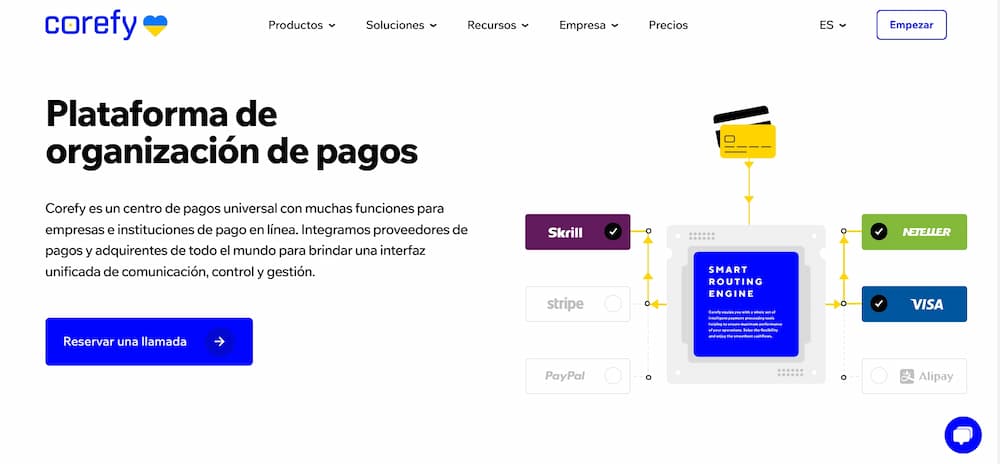
Getting into its definition, Corefy is a payment orchestration platform (payment orchestration platform) designed for online payment companies and institutions.
In simple terms, acts as a universal payment center that connects multiple payment providers and acquirers from around the world in a single interface.
What's the result? Well, It allows businesses to accept payments, process them, optimize routes, and manage everything from one place. instead of having to be integrated separately with each processor.
That way, it gives you control total Regarding the payment flow, you can automatically route each transaction to the most convenient provider based on cost, approval rate, country, or currency, reducing risks and improving conversion rates.
Key features of Corefy
- Connection with more than 1,200 suppliers paid.
- Support for over 250 payment methods.
- More than 200 coins (including cryptocurrencies).
- Intelligent routing and cascading.
- Ready-to-use integrations (more than 600).
- Tools for analyzing, tokenizing, and personalizing the payment experience.
What you can do with the catwalk
Imagine you have several payment processors: one that works better in Europe, another that gives you better commissions in Latin America, a third that accepts cryptocurrencies, and another that has the highest approval rates for cards.
Until now, to use them all, you'd have to integrate with each one separately, maintain multiple dashboards, and deal with reports from each one. A nightmare.
Corefy eliminates that hassle. It acts as a universal payment hub. It connects all those providers in a single interface. From there, you can accept payments, process them, automatically choose the best processor for each transaction, and manage everything without jumping from one platform to another.
What do you gain from this?
For a start, It allows you to route each transaction to the most convenient provider depending on what matters most to you at that moment: the cost of the commission, the approval rate, the customer's country, or the currency they are using.
If a card fails in one processor, the system can automatically redirect it to another without the client noticing. This is called cascading, and it improves your conversions without you having to lift a finger.
You also reduce certain risks.Because you don't depend on a single provider, if one goes down or closes your account, you can still operate with the others.
And all this with analytics tools, tokenization of sensitive data, and the ability to customize the payment experience to suit your brand and your customer.
What types of businesses is Corefy suitable for (and which ones is it not)?
Corefy is not for a business that receives four payments a month with a single card. It is designed for complex or high-volume operations And the sectors where it's most used will give you an idea:
- iGaming and bettingwhere approval rates and speed matter a great deal.
- Forex y trading with overlapping regulations and diverse payment methods.
- Cryptocurrencies (where currency and wallet flexibility is key).
- Adult content and dating, high-risk sectors with specific needs.
- PSPs and payment service providers who need to manage their own merchants.
- International e-commerce with clients in dozens of countries and local payment methods.
So, what businesses isn't Corefy a good fit for? Well, if you have a small online store, sell a couple of digital products a month, or handle less than a few tens of thousands of dollars in annual transactions, Corefy is probably more powerful than you need.
In that case, a traditional gateway like Stripe, PayPal, or even a simpler solution will give you what you're looking for without the complexity or cost of an orchestration platform.
It may also not make sense if you work with a single payment processor and don't plan to diversify in the short term.
Corefy limitations you should be aware of

Let's be honest. While Corefy is a powerful payment orchestration platform, it's not the ideal solution for every business, and these are the limitations most frequently mentioned by users and experts on platforms like Reddit, Quora, and Trustpilot:
- High technical complexityInitial configuration and intelligent routing require advanced technical knowledge. It is not a plug-and-play tool, and many companies need a development team during implementation.
- High costTheir plans are premium, with the most basic plan starting at approximately $2,400 USD per month (with a limited number of transactions included). This is not cost-effective for low- or medium-volume businesses.
- Steep learning curveThe interface and advanced features can be difficult to use without proper training.
- Heavy initial integrationConnecting multiple providers and configuring cascading/routing can take time and resources.
- Not recommended for low volumesIf you don't process a high number of monthly transactions, the monthly fixed cost usually outweighs the benefits.
You can see that Corefy shines in high-volume, high-complexity environments, but it can be overkill and expensive for smaller businesses or those with simpler needs.
What do users say? Pros and cons of Corefy
Opinions about Corefy vary depending on the size of the business. While large companies praise its power, smaller entrepreneurs often struggle with its complexity.
| Positive aspects (What they value most) | Negative aspects (What they criticize most) |
| Omnichannel: Centralize more than 1,200 suppliers in a single panel. | Technical support: Reports of slowness and lack of response in critical integrations. |
| Intelligent routing: It increases the approval rate and reduces operating costs. | Learning curve: Complex interface that requires advanced technical knowledge. |
| Scalability: It supports over 200 currencies and crypto asset payments. | High costs: Rates that may be prohibitive for low-volume businesses. |
| Automation: Robust reconciliation and real-time monitoring tools. | Slow implementation: The initial setup process is longer than expected. |
| Data Power: In-depth analysis for companies with multiple PSPs. | Manual intervention: Occasional failures in the automatic reconciliation of balances. |
On platforms like Trustpilot and G2Corefy is the favorite choice of the merchants high-volume, while SMEs tend to prefer simpler alternatives due to the technical and economic barrier.
When does it make sense to look for an alternative to Corefy?
Yes, we know, Corefy is a powerful tool, but it's not for everyone. If your business doesn't operate with dozens of processors, you don't need to route transactions globally.
You also don't need it if your payment volume doesn't yet require advanced orchestration; so paying for a platform of that caliber can be like buying a truck to deliver pizzas in the neighborhood.
There are also cases where, even if you have volume, What you really need is not more complexity, but more simplicity.
In those scenarios, an orchestration platform can feel like an additional layer that complicates more than it solves.
It's not very helpful in this case either.
And then there's the issue of control. Corefy gives you control over how your payments are routed between multiple providers, but if what you're looking for is total control over your own money—when you withdraw it, in what currency you receive it, without endless holds—then the problem is different.
RiskPayGo is the best alternative to Corefy if you're looking for simplicity and complete control.
This is where it comes in RiskPayGoIt doesn't try to be an integration platform that connects hundreds of processors. Not at all, since its approach is different and, for many businesses, much more useful in day-to-day operations.
This payment gateway gives you what you really need when you're already operating in high-risk sectors: a reliable processor that doesn't complicate your life.
Registration is quick, the dashboard is clear, and above all, the money arrives when it's supposed to. No endless reservations, no complicated formulas to figure out how much they'll hold.
And the total control we're talking about comes from these characteristics:
Withdrawals from $10You don't have to accumulate hundreds or thousands to see your money; you can withdraw it when you need it, not when the platform decides you've reached the minimum.
You receive direct cryptocurrency payments, so you're not dependent on banks that might scrutinize you for operating in high-risk sectors. Your money arrives in your wallet, in USDC or other cryptocurrencies, and from there you can do whatever you want.
Our final verdict: when to use Corefy and when RiskPayGO is better
If Corefy is for those who need processor integrationRiskPayGo is for those who want a single instrument that works well. Don't fail and hand in the score without delay.
Therefore, if your priority is operational simplicity, fast liquidity, and having real control of your money without intermediaries, RiskPayGo isn't just an alternative to Corefy, it's probably the best. the smartest option for your business.
Frequently Asked Questions
What is the best alternative to Corefy?
RiskPayGo is the best alternative if you need a more agile solution, with less technical complexity and greater control over your collections, especially if they include modern methods such as cryptocurrency payments.
Is Corefy a payment gateway or a payment aggregator?
Corefy is not a traditional gateway, but a payment orchestration platform that connects multiple providers in a single system, allowing you to manage and optimize transactions from a single dashboard.
Is Corefy suitable for small businesses or is it better for high volumes?
This site is geared more towards businesses with high transaction volumes or complex needs. But for small businesses or projects seeking speed and simplicity, it may be too costly and difficult to set up.